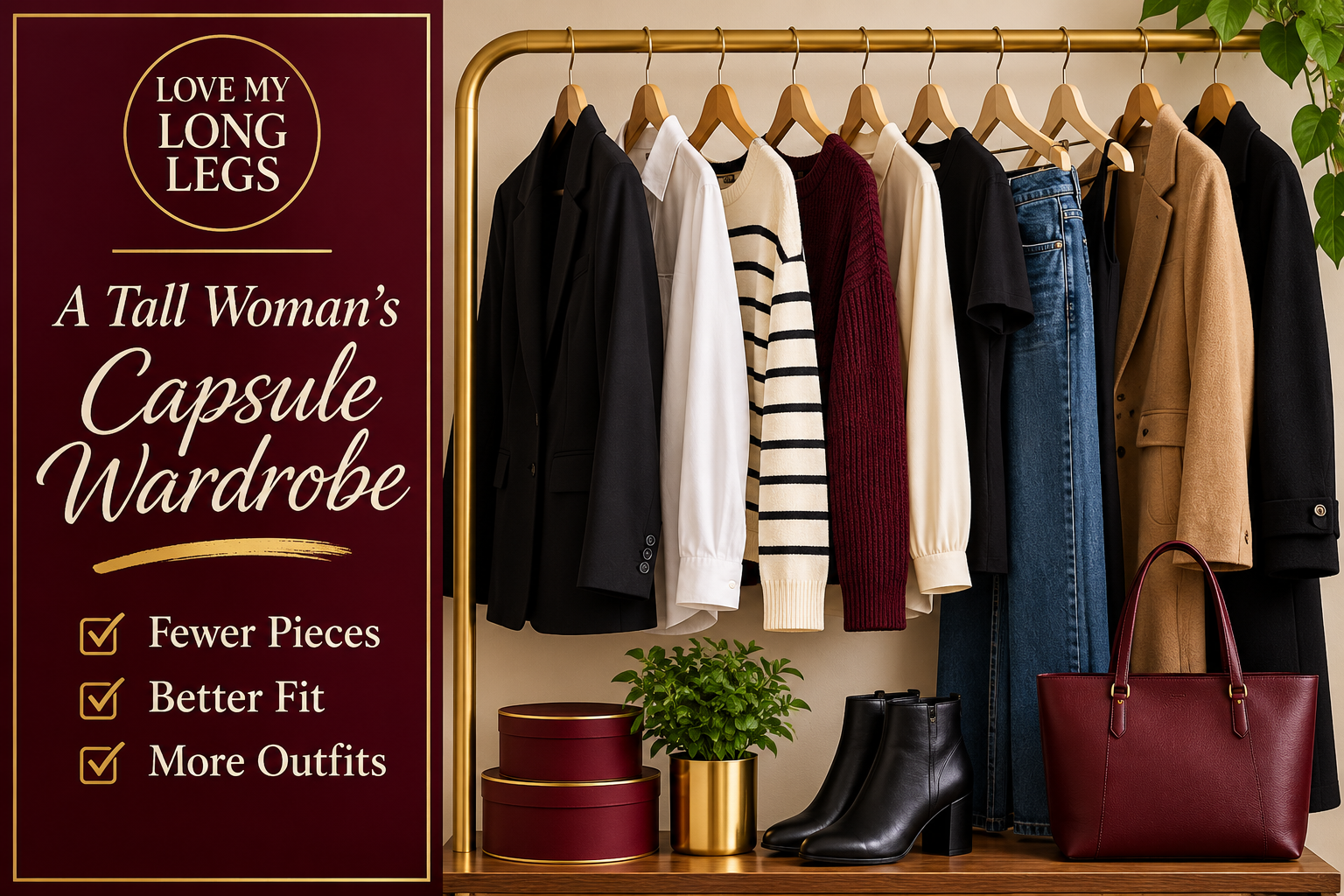
Building a capsule wardrobe sounds simple enough. Buy a few timeless pieces, make sure everything works together, and voilà! A closet full of outfits.
Cute idea.
Now try doing that when you’re tall and half the so-called wardrobe essentials look like they shrank in somebody’s dryer.
The trousers are auditioning for capris. The blazer sleeves are exposing your wrists. And that adorable midi dress? Ma’am, that’s a knee-length dress with a marketing problem.
Finding clothes that fit properly can already feel like a part-time job. Finding clothes that fit, look good, and actually work together? That’s a whole different assignment.
But here’s where a capsule wardrobe can make life easier.
Instead of collecting random pieces that don’t play nicely together, you build a smaller wardrobe around clothes you genuinely love, wear regularly, and—this part is important—actually fit your tall frame.
And no, you don’t have to throw away your entire closet, spend $2,000 on beige clothing, or suddenly become a minimalist who owns three shirts and one pair of sensible shoes.
We’re building a wardrobe, not joining a monastery.
What Is a Capsule Wardrobe?
A capsule wardrobe is a thoughtfully selected collection of clothing that can be mixed and matched to create multiple outfits.
The concept became popular in the 1970s through London boutique owner Susie Faux, who promoted the idea of building a wardrobe around versatile, timeless pieces.
Today, capsule wardrobes come in all shapes and sizes. Some people stick to 30–40 pieces. Others prefer smaller seasonal collections.
But here’s the thing: there is no magical number.
Your capsule should reflect your lifestyle, personal style, climate, and what you actually wear.
If you work from home, you probably don’t need five blazers. If you practically live in dresses, there’s no reason to force yourself into trousers every day.
And if your favorite color is bright orange, please don’t let Pinterest convince you that happiness only comes in camel, cream, and black.
A successful capsule wardrobe generally includes:
- Versatile pieces: Clothing that works with several other items.
- A coordinated color palette: Colors that complement one another without limiting your personality.
- Reliable fit: Pieces that feel comfortable and flatter your proportions.
- Quality where it matters: Clothing that holds up to regular wear.
- Lifestyle flexibility: Outfits that work for your actual daily activities.
The goal isn’t to own the fewest clothes possible.
It’s to own clothes you actually want to wear.
Why Capsule Wardrobes Make Sense for Tall Women
For tall women, shopping isn’t always as simple as walking into a store and grabbing your usual size.
We have additional measurements to think about.
Inseams. Sleeve lengths. Torso lengths. Rise measurements. Waist placement. Shoulder proportions.
And sometimes, after checking all of that, the item still fits like somebody designed it during a power outage.
That’s why a capsule wardrobe can be particularly useful.
When you finally find a great pair of trousers with the right inseam, a blazer with sleeves that reach your wrists, or a dress with the waistline in the correct ZIP code, you want to get as much use out of those pieces as possible.
A capsule wardrobe encourages you to:
- Spend less time searching for replacement basics.
- Build multiple outfits around hard-to-find tall-friendly pieces.
- Avoid buying clothing simply because it happens to be long enough.
- Focus your budget on items you’ll wear frequently.
- Identify wardrobe gaps before making another purchase.
And perhaps most importantly, it helps you stop settling.
Because “it fits” and “I actually like it” should not be mutually exclusive.
10 Capsule Wardrobe Essentials for Tall Women
Before we get into the list, remember that these are suggestions, not commandments.
Your wardrobe doesn’t need every single item. Choose the pieces that work for your lifestyle and personal style.
1. Jeans That Actually Reach Your Shoes
A great pair of jeans is one of the hardest-working pieces in any wardrobe.
Straight-leg, wide-leg, bootcut, or slim-fit—choose whichever silhouette you love.
Tall-girl fit check:
Pay attention to more than the inseam. Check the rise, knee placement, and where the jeans fall over your shoes.
A 36-inch inseam might be perfect for one tall woman and too short for another. Your height alone doesn’t determine your inseam.
And remember, different jean styles may require different lengths.
A wide-leg jean intended to skim the floor won’t necessarily need the same inseam as an ankle-length straight-leg style.
For more guidance, check out our Ultimate Guide to Inseams: How to Measure and Shop for Your Height.
2. Tailored Trousers
A well-fitting pair of trousers can take you from the office to dinner without much effort.
Black, navy, charcoal, and other versatile colors are great starting points.
Tall-girl fit check:
Look at where the rise sits, how the fabric falls through the hips, and whether the knees are positioned correctly.
For full-length trousers, try them on with the shoes you expect to wear most often.
And please, don’t convince yourself that trousers hovering three inches above your shoes are supposed to look like that.
Unless cropped is the look you’re going for, we are not accepting accidental floods.
3. Button-Down Shirts With Proper Sleeve Length
A crisp button-down can work with jeans, trousers, skirts, and layered outfits.
But standard-size shirts can be especially frustrating for women with long arms or longer torsos.
Tall-girl fit check:
Check that the sleeves reach your wrists when your arms are relaxed, the shoulder seams sit appropriately, and the shirt has enough length to stay tucked if that’s how you plan to wear it.
Also check the bust and button placement. A shirt that fits your arms but pulls across your chest isn’t doing its job.
4. Quality Tees and Long-Sleeve Tops
These are the everyday workhorses of your wardrobe.
Choose comfortable fabrics that hold their shape and don’t become transparent after two washes.
Tall-girl fit check:
Look for adequate body length, properly placed waist shaping, and sleeves that don’t creep halfway up your forearms.
A regular tee can work beautifully for some tall women, especially those with shorter torsos.
Others may need tall-specific cuts.
The goal is to understand your proportions rather than assuming every tall woman needs the same fit.
5. A Blazer That Fits Your Proportions
A blazer can make jeans look polished and give a simple outfit a completely different personality.
But blazers are also where standard sizing can get disrespectful.
Tall-girl fit check:
Pay attention to sleeve length, shoulder fit, button placement, and where the blazer’s waist shaping lands.
If the jacket is designed to nip in at the waist but that shaping sits near your ribs, the proportions are off.
A tailor may be able to adjust the waist, but correcting major proportion problems can be expensive or impossible.
6. A Coat With Sleeves That Understand the Assignment
Depending on your climate, this might be a trench coat, wool coat, lightweight jacket, or something warmer.
Tall-girl fit check:
Make sure the sleeves are long enough when you move your arms, the shoulders fit comfortably over layers, and any belt sits where it’s intended.
A coat that looks beautiful while you’re standing perfectly still but exposes half your forearm when you reach for something isn’t particularly practical.
7. Versatile Knitwear
A crewneck sweater, cardigan, or lightweight knit can add variety without requiring a completely different outfit.
Tall-girl fit check:
Check sleeve length, overall body length, and how the sweater falls over your waist and hips.
An intentionally cropped sweater is one thing.
A regular sweater that unexpectedly becomes cropped because you’re tall? That’s a different conversation.
8. A Dress That Fits Your Actual Waistline
A simple dress can be one of the easiest pieces in a capsule wardrobe.
Shirt dresses, wrap dresses, knit dresses, and A-line styles are all worth considering.
Tall-girl fit check:
Check the waist seam, bust placement, torso length, and hemline.
A dress labeled midi may hit above your knees. A dress labeled maxi may stop at your ankles.
Neither is necessarily a problem if you love the look.
The problem is when the garment doesn’t match the fit you’re expecting.
9. A Skirt You Can Style Multiple Ways
A midi skirt, slip skirt, or classic A-line skirt can work with tees, sweaters, and button-downs.
Tall-girl fit check:
Check the actual garment length instead of relying on the retailer’s description.
The same skirt can look dramatically different on someone who is 5’4” versus someone who is 6’1”.
And there’s nothing wrong with showing a little leg.
We just prefer to decide how much leg we’re showing before leaving the house. 😂
10. Shoes and Accessories That Work With Your Wardrobe
You don’t need 25 pairs of shoes to build a functional capsule.
A few versatile options might include sneakers, loafers, boots, flats, or dress shoes.
Choose what fits your lifestyle.
For tall women who wear larger shoe sizes, finding a comfortable, attractive pair can be just as challenging as finding clothing.
When you find shoes that fit well, work with multiple outfits, and don’t make your feet miserable, that’s a win.
And yes, tall women can wear heels.
We didn’t grow all these legs just to spend our lives apologizing for them.

A Simple 15-Piece Starter Capsule Wardrobe
Now let’s put this into practice.
You don’t need to start with 40 items. Here’s a sample 15-piece clothing capsule that can create multiple outfits without requiring an enormous closet.
Tops — 5 pieces
- White or cream tee
- Black or navy tee
- Long-sleeve top
- Button-down shirt
- Versatile sweater
Bottoms — 4 pieces
- Dark-wash jeans
- Casual jeans or a second favorite pant
- Tailored trousers
- Midi skirt
Layers — 3 pieces
- Blazer
- Cardigan
- Coat or lightweight jacket
Dresses — 2 pieces
- Everyday dress
- Dressier versatile dress
Wildcard — 1 piece
- Something you absolutely love that reflects your personality
That last piece might be a colorful blouse, statement jacket, printed trousers, or whatever makes you feel fabulous.
Because a capsule wardrobe should be practical, but it should never be boring.
Shoes, bags, workout clothes, sleepwear, and special-occasion clothing can be handled separately. You decide what belongs in your capsule.

How Many Outfits Can You Make?
Here’s where things get interesting.
Using just a few of those pieces, you could create:
- Outfit 1: Dark jeans + white tee + blazer + sneakers
- Outfit 2: Tailored trousers + button-down + loafers
- Outfit 3: Midi skirt + sweater + ankle boots
- Outfit 4: Casual jeans + long-sleeve top + cardigan
- Outfit 5: Everyday dress + blazer + flats
- Outfit 6: Tailored trousers + black tee + cardigan
- Outfit 7: Dark jeans + button-down + ankle boots
- Outfit 8: Midi skirt + white tee + sneakers
That’s eight outfits without even using every combination.
The secret isn’t owning a huge wardrobe.
It’s making sure the pieces you own actually work together.

What Tall Women Should—and Shouldn’t—Get Tailored
Let’s discuss tailoring, because this is where a little money can make a big difference.
A good tailor can improve the fit of clothing you already own and help extend its useful life.
But there’s one very important thing tall women need to understand:
A tailor can usually remove excess fabric. Adding length is a whole different story.
If a pair of trousers is too long, shortening them is generally straightforward.
If they’re three inches too short and there’s no extra fabric in the hem?
Baby, that tailor is talented, not magical.
Alterations Worth Considering
Trousers and jeans: Adjusting a waistband, hemming overly long pants, or refining the leg shape.
Blazers: Taking in the waist, adjusting the back, or making minor sleeve-length changes when enough fabric is available.
Button-down shirts: Taking in excess fabric through the sides for a cleaner fit.
Dresses: Adjusting straps, taking in the bodice, or refining the waist when the original construction allows it.
Coats: Minor fit adjustments, button repositioning, or repairs that extend the garment’s life.
Alterations That May Not Be Worth the Money
Be cautious when a garment needs major changes to the shoulder structure, armholes, rise, or waist-seam position.
These alterations can be complicated, expensive, and sometimes impossible without rebuilding significant parts of the garment.
Before buying something that needs work, ask a tailor whether the alteration is realistic and what it will cost.
Because buying a $60 blazer and spending $150 trying to convince it to fit is not necessarily a bargain.
Where to Shop for Tall Wardrobe Basics
Finding reliable tall clothing is easier when you know which retailers offer true tall sizing and which simply offer longer lengths.
And yes, there’s a difference.
True tall sizing may account for longer sleeves, torso proportions, rise measurements, and garment length.
Long or extra-long options may only change one measurement, such as the inseam.
Neither is automatically better. What matters is whether the garment fits your body.
Some retailers worth checking include:
- Old Navy: A useful starting point for budget-friendly tall basics, denim, and casual clothing.
- Gap: Worth exploring for denim, tees, and everyday staples in tall sizing.
- Banana Republic: A potential source for polished basics and workwear, depending on current availability.
- American Tall: A specialty retailer focused on clothing designed for taller bodies.
- Long Tall Sally: A longstanding tall-focused retailer offering multiple wardrobe categories.
- J.Crew: Worth checking for classic pieces offered in tall sizes.
- Athleta: A possible option for tall-friendly activewear and casual pieces.
Availability, sizing, and inseam options can change, so always check current product measurements before ordering.
And don’t overlook independent tall-fashion brands.
Some of the most interesting options come from smaller businesses created by women who understand the frustration of finding clothing that fits.
For more places to shop, explore the Love My Long Legs Tall Women’s Clothing Brand Directory, where we’re collecting tall-friendly retailers in one convenient place.
Tall Brand Spotlight: TTYA Lab
Well, look what we found! 👀
TTYA Lab, a UK fashion brand designing specifically for taller women, has introduced DROP.001, a collection built around versatile wardrobe pieces you can wear again and again.
Sound familiar? That’s practically the definition of a capsule wardrobe!
The collection includes tailored trousers, blazers, shirts, dresses, and outerwear designed to work together. And here’s something we especially appreciate: selected trousers offer 36-inch and 38-inch inseams.
Now, we’re not handing out gold stars just yet. We’d still love to see detailed sleeve and garment measurements across the collection. Because a gorgeous blazer with sleeves that don’t reach your wrists is not the victory we’re looking for.
But for tall women interested in building a coordinated wardrobe, TTYA Lab is definitely a brand worth exploring.
How to Build Your Capsule Wardrobe Without Blowing Your Budget
A capsule wardrobe doesn’t require a shopping spree.
Actually, I’d argue that rushing out to buy an entirely new wardrobe defeats the purpose.
Here’s how to build one without giving your bank account a nervous breakdown.
Start With What You Already Own
Go through your closet and identify the pieces you wear most often.
Which jeans fit perfectly? Which tops make you feel confident? Which colors do you naturally reach for?
Those pieces are the foundation of your capsule.
You may already own more of your ideal wardrobe than you realize.
Make a Shopping List Before You Shop
Once you know what you have, identify what’s missing.
Maybe you need a blazer with longer sleeves. Maybe your jeans are great, but you don’t have trousers that work for dressier occasions.
Write down your actual needs.
And when you find something cute that isn’t on the list, ask yourself whether it works with at least three pieces you already own.
If the answer is no, you might want to keep scrolling.
I said might. We’re building better habits, not pretending temptation doesn’t exist. 😂
Think About Cost Per Wear
A $150 coat worn 100 times costs $1.50 per wear.
A $30 top worn twice costs $15 per wear.
The more you wear something, the more value you get from the purchase.
That doesn’t mean expensive clothing is automatically better. A reasonably priced item that fits well and lasts can be an excellent investment.
Spend thoughtfully on the pieces you wear most often.
Shop Secondhand
Resale platforms like Poshmark, eBay, and thredUP can be useful for finding tall clothing from previous seasons.
Search for specific brands, sizes, and inseam measurements.
Whenever possible, ask sellers for actual garment measurements.
Because buying secondhand clothing that doesn’t fit is still buying clothing that doesn’t fit.
Watch for Sales
Tall clothing can be expensive, especially when shopping specialty retailers.
Seasonal promotions, clearance events, and email discounts can help stretch your budget.
Just remember that something being 60% off doesn’t automatically make it a good purchase.
If you wouldn’t wear it at full price, think carefully before buying it on sale.
Don’t Ignore the Men’s Department
For relaxed or oversized styles, men’s sweaters, shirts, and jackets may offer useful sleeve and body lengths.
Just pay attention to shoulder width, waist shaping, and overall proportions.
A longer garment isn’t automatically a better-fitting garment.
Build Slowly
You don’t need to complete your capsule in one weekend.
Add pieces as you find them.
For tall women, especially, waiting for the right fit is often smarter than settling for something that’s almost right.
We’ve all made the “it’ll work” purchase.
And we’ve all had that item hanging in the closet three years later, still waiting for it to work.
Your Capsule Wardrobe Should Fit YOU
Here’s something I want every tall woman to remember.
A capsule wardrobe isn’t supposed to erase your personality.
If you love bold prints, wear them.
If you prefer dresses over jeans, build around dresses.
If you love heels, wear the heels.
And if you’re happiest in sneakers and comfortable clothes, that’s perfectly fine too.
You don’t need to dress like someone else to have a well-organized wardrobe.
You simply need clothing that fits your body, supports your lifestyle, and makes you feel good.
Being tall doesn’t mean you have to limit your style.
It means being a little more intentional about finding the pieces that work.
The Bottom Line
Building a capsule wardrobe when you’re tall isn’t about owning less just for the sake of owning less.
It’s about getting more out of the clothes you already have, making smarter purchases, and finally creating a wardrobe where everything works together.
Start with your favorites. Learn your measurements. Invest in fit. Fill the gaps slowly.
And please, stop buying clothes that don’t fit just because they’re the longest option available.
You deserve more than clothes that are merely long enough. You deserve clothes that fit beautifully and make you feel like yourself.
Stand tall. Wear what you love. And let those legs live their best lives.
Stand Tall. Stay Informed. Love Your Long Legs.